Muslim Background Believer Attrition Study
Gordon Bonham, Gene Daniels, and Sara Hewitt
Published in Global Missiology, www.globalmissiology.org, January 2026
Abstract
A mixed methods study of about 100 church leaders working with Muslim Background Believers (MBBs) estimates that about 7% of known MBBs later return to Islam. This estimated percentage is a significant contrast to past reports of very high rates of return to Islam. A key issue in coming to this figure is differentiating between those who actually return to Islam and those who do not continue with the existing church for various other reasons. Although many MBBs find fellowship in local churches, the study suggests that integration into MBB fellowships is both a key factor in the strong individual faith of MBBs and a primary element of support against the great pressures on them to return to their former faith.
Key Words: church, fellowship, MBB, Muslim, reversion
Background
The last few decades have been an unprecedented time of ministry in the Muslim world, with evidence pointing toward large numbers of Muslims turning to Christ around the world. Exact numbers are impossible to know, but in a summary of sources Daniels published an estimated growth from 1850 to 2020, as seen in Figure 1 below (Daniels, 2021).
 Together with recognizing
this tremendous growth comes acknowledging that ministry in the Muslim world is
full of difficulty and uncertainty. Such ministry can be rewarding and
disappointing at the same time. One issue that vexes many analysts is that of
Muslim Background Believers (MBBs) who seem to leave the faith. This apparent
reality raises many questions, for example: What happens when Christians lose
touch with new MBBs? Do they return to Islam or just become secret believers?
What are the real numbers for those who leave their newfound faith, and what
are the factors Fig.
1.
Growth of MBBs worldwide
Together with recognizing
this tremendous growth comes acknowledging that ministry in the Muslim world is
full of difficulty and uncertainty. Such ministry can be rewarding and
disappointing at the same time. One issue that vexes many analysts is that of
Muslim Background Believers (MBBs) who seem to leave the faith. This apparent
reality raises many questions, for example: What happens when Christians lose
touch with new MBBs? Do they return to Islam or just become secret believers?
What are the real numbers for those who leave their newfound faith, and what
are the factors Fig.
1.
Growth of MBBs worldwide
that most contribute to that move?
Various researchers and writers have raised similar questions, often suggesting that the rate of those returning to Islam is quite high, even in the 90% range (Span, 2020). And while many have recognized the need for further research, the complex theological, social, and security issues involved are a daunting obstacle. Nevertheless, in 2024 the Communio Messianica (Communio Messianica, 2025) approached the Global Research Team (GRT)—of which we the authors are members—with a request for us to conduct an empirical study of questions associated with MBB reversions. With some trepidation we decided to take up that request because it seems to be God’s kairos time for a better understanding of what he is doing in the Muslim world.
Methods
It was important that the research yield two results: one, offer a measurable rate of perceived return of MBBs to Islam that happens after a clear profession of faith in Christ, and two, better understand the pressures MBBs face as well as what helps keep them strong in Christ. The investigation of the first, that is the rate of return to Islam, was not easy to investigate: that is why the MBB survey was designed to explore the issue through the perspective of those who serve in ministry—what they had seen. The survey focused on the various forms of both church integration and faith reversion. A set of Likert-structured questions was developed to assist the measure of a rate of return to Islam that study participants had observed. The twelve-question survey included six questions about the current relationship with Jesus and the Church of Muslims who had put their faith in Jesus Christ and six standard demographic questions. In anticipation of its broad distribution, the survey was developed in four languages: Arabic, English, French, and Turkish. A PDF form of the survey was approved for use, and a secure online survey link was established, including the same four language options.
The survey was promoted and distributed in the summer of 2024 among church leaders working with Muslims, primarily in the Middle East and diaspora populations in Europe. During the first month of the survey, participants were mostly church leaders and members attending regional ministry conferences. During the second month, participants were primarily from the attendees of an international organization’s conference promoting gospel ministry to the Muslim world.
Most of the questions in the survey had pre-defined answer choices. However, two questions had a place for participants to make comments on their choice, or lack of choice, of a pre-defined answer. Then, beginning in late 2024, additional qualitative data was gathered through in-depth interviews with survey participants who said they were willing to participate in follow-up interviews.
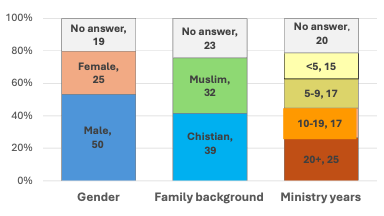 During the summer of 2024, 94 people ministering
with MBBs completed the online survey. The majority (57) completed the English
version, 36 completed the Arabic version, and one completed the French version.
(The Turkish version was not used.) There were 54 participants who reported
Arabic as their primary ministry language, with more than ten other ministry
languages mentioned. Qualitative data was collected in both Arabic and English.
Most participants live in the Middle East and North Africa, with many in
Turkey. Twice as many men (50) Fig. 2. Characteristics of survey participants
During the summer of 2024, 94 people ministering
with MBBs completed the online survey. The majority (57) completed the English
version, 36 completed the Arabic version, and one completed the French version.
(The Turkish version was not used.) There were 54 participants who reported
Arabic as their primary ministry language, with more than ten other ministry
languages mentioned. Qualitative data was collected in both Arabic and English.
Most participants live in the Middle East and North Africa, with many in
Turkey. Twice as many men (50) Fig. 2. Characteristics of survey participants
as women (25) responded to the question on gender; slightly more came from a Christian background (39) as from a Muslim background (32); the largest group (25) had been in Muslim ministry for 20 or more years, and the fewest (15) had been in ministry less than five years (see Figure 2 above). Participants gave a wide range of answers to their ministry positions, including pastors, worship leaders, church members, missionaries, Bible teachers, and organizational leaders.
As a follow-up during the first few months of 2025, 13 of the survey participants responded to a set of in-depth questions. Seven were interviewed through Zoom (three through an Arabic translator), and six responded via email. Many of the quotations in this article are from these follow-up responses, which have been lightly edited.
Findings
The responses to the first five of the questions in the survey were used to estimate the percent of MBBs who have returned to Islam. Next were two questions to better understand the pressures MBBs face and what helps keep them strong in Christ. Qualitative data from responses entered in the online survey and given during the follow-up interviews have been included whenever they offer further insights.
Question 1: Number Known
“About how many former Muslims do you personally know who became a true follow of Jesus?”
 This
question helped orient the participant to the purpose of the study and gave a
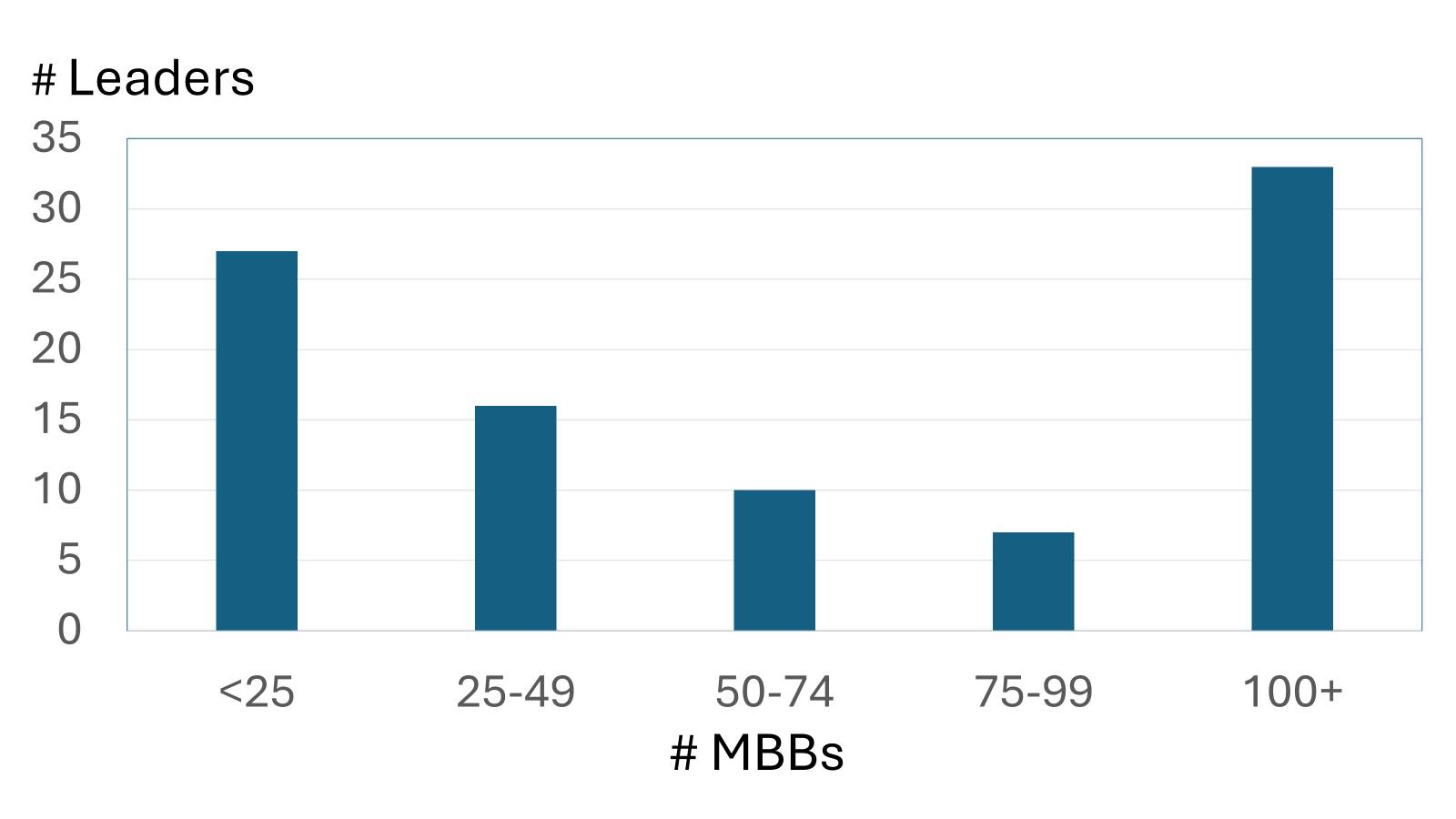
context to understand their subsequent responses. Most participants (27) indicated
that they knew either fewer than 25 Muslims or 100 or more (33). (See Figure 3.) The others knew
various numbers in between. On average, they knew about 68 MBBs. There was no
statistical relationship between any of the participants characteristics and
the number of MBBs whom they have known.
This
question helped orient the participant to the purpose of the study and gave a
context to understand their subsequent responses. Most participants (27) indicated
that they knew either fewer than 25 Muslims or 100 or more (33). (See Figure 3.) The others knew
various numbers in between. On average, they knew about 68 MBBs. There was no
statistical relationship between any of the participants characteristics and
the number of MBBs whom they have known.
There was no statistical relationship between any of the demographic information and the number of MBBs whom the respondents have known.
Fig. 3: Number of MBBs leaders have known
Question Two: Number Dropped Out
“How many of these Muslim Background Believers (MBB) do you know who have simply dropped out of contact with you and other Christians?”
Three-fourths of the participant church leaders said that None (light blue-colored) or Few (light green-colored) of the Muslims they had known that had accepted Jesus have subsequently dropped out of contact with them (see Figure 4 below). This result paints a very encouraging picture. It also suggests the reliability of the participants’ answers to the remaining questions. The remainder of the church leaders said Many or Most (reddish and dark blue) of the MBBs they had known had dropped out of contact. The more MBBs that the leader had known, the more likely they were to say either Many or Most of them had dropped out of contact, but the number was never more than 40% for those who had known 100 or more MBBs.
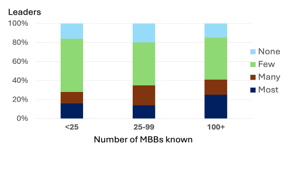 We should point out that church leaders with Muslim backgrounds
reported a greater proportion of MBBs who have dropped out of contact than did
those with other religious backgrounds. None of the
other demographic characteristics of the leaders had any relationship with the
percentage dropping out.
We should point out that church leaders with Muslim backgrounds
reported a greater proportion of MBBs who have dropped out of contact than did
those with other religious backgrounds. None of the
other demographic characteristics of the leaders had any relationship with the
percentage dropping out.
We have so much compelling qualitative data on this point that it is difficult to select what to use. First, one major reason that MBBs “disappear” is that, in retrospect, it is questionable if they were ever believers in the first place. This reality turned up in several interviews, for example the
following two: Fig. 4. % of leaders by # of MBBs who have dropped out of contact
There are actually people in our location who have become Christian, and as soon as they get their residence permits in the country, they actually leave the church at that point and they start attending the mosque.
One of the goals of pretending to be a believer, that we faced a lot in our church that some believers after they get baptized, they want [a special] baptism certificate to be able to leave [country] and live abroad. So when the Church does not help them with this traveling abroad thing, they don't have anything more to do with it. They leave the church.
However, sometimes there is a problem with both the MBBs and the church; both seem to have questionable motives:
Refugees come to the church hoping that they will have a stable kind of income… [But they] are showing themselves at churches who are interested in collecting people, and taking photos, and then send it to the donors. [They say], ‘Look, we have believers.’ So the church in the first place isn't a real church, or perhaps the believer himself, is not a believer.
One participant painted an even more disturbing picture:
[Sometimes] what is taking place here is that churches are selling Christ. ‘Come to the church and have aid’ [they say]… so the Muslim will believe in Christ, thinking that the church will keep supporting him for the rest of his life… then [after] he accepted Christ, the support of the aid could end, so he will stop being a Christian. He will quit the Christian faith because from the first place it was given for a price and that price is no more.
But such insincerity and deception are not the only reasons MBBs disappear. Sometimes it is against their will:
[As for a new MBB woman] her family could lock her up at the home and never allow her to go out to meet other Christian women who are from the first place introduced Christianity to her and [her] daughters.
In Eastern culture a man can always move to another city, start over. A woman cannot. She doesn't have many options. Girls are raised in prison-like homes, so they are more apt to hide their faith, whether a wife or daughter.
Also, the conventional view of Muslim culture would assume this family pressure only goes one way because of an almost all-powerful Muslim husband. However, some respondents spoke of the opposite; one MBB leader put it this way:
I know several of these situations where the pressure from the wife at home is so strong that it's very difficult for the husband to come to church… And also there's like a blackmailing. If there's a child in the family and the [unbelieving] wife is saying ‘if you go to church, I will go with our child to my parents’ … or something like that. It’s like punishment pulling the family apart.
All this information reminds us that the picture can be quite complicated when an MBB drops out of sight from their fellowship, since only God truly knows the heart.
Question Three: No Spiritual Home
“How many of these MBB’s do you know who could not find a spiritual home in their local church and desire to be part of a congregation primarily composed of MBBs?”
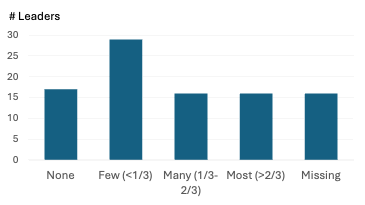 More than half of church leaders reported that None
(17) or only a Few (41) of the MBBs about whom they still had information
desired an MBB congregation, as they had not found a church home (see Figure 5). One-third said Many
(16) or Most (16) had not found a church home and desired an MBB congregation
or fellowship. The remainder did not answer the question. This information
suggests that the majority of the MBBs that participants were still in contact
with remain strong in their faith and are involved in local churches. Fig. 5. No spiritual home, desire an MBB congregation
More than half of church leaders reported that None
(17) or only a Few (41) of the MBBs about whom they still had information
desired an MBB congregation, as they had not found a church home (see Figure 5). One-third said Many
(16) or Most (16) had not found a church home and desired an MBB congregation
or fellowship. The remainder did not answer the question. This information
suggests that the majority of the MBBs that participants were still in contact
with remain strong in their faith and are involved in local churches. Fig. 5. No spiritual home, desire an MBB congregation
We find this perseverance very encouraging. Nevertheless, there appears to be a very real need for more MBB congregations if one-third of MBBs need an MBB congregation to find a spiritual home. This survey also suggests the need for more robust follow-up with MBBs so fewer church leaders would feel the need to skip answering this question (missing category).
The qualitative interviews provide a wide range of reasons why some MBBs do not find a spiritual home in the local church:
Although the two [groups] are belonging to the same society, they are two different cultures, so they don't understand each other correctly and they keep being skeptic about each other.
This cultural gap can cause frustration for the MBBs:
Some of them [MBBs] are angry at how Christians treat them in the church, or feel that they do not believe them or question their faith. Some of them feel that they are second or third class ... Some of them [MBBs} feel that they are not wanted to marry their children because they are from an Islamic background and their parents are Muslims” [emphasis added].
That last sentence is particularly noteworthy. Social and cultural differences may seem abstract, but here is an example of one very practical problem those differences can cause—resistance to intermarriage. One person explained how devastating this resistance can be:
And singles [MBBs] have not found opportunities to marry in the [Christian] communities. Some say that rejection by Christian background people is more painful than rejection by unconverted Muslims. Their only hope is to find an MBB community.
The last part of the previous quote is powerful: “Their only hope is an MBB community.” This is perhaps the core reason why many MBBs do not find a spiritual home in the existing church—they are not looking for an organization to join, but a community to be part of:
It's not pressure, but the desire to be part of community. And the MBBs have not found acceptance with Christian background believers. They have not found a Christian replacement for the family and community that they lost.
Another way that cultural difference negatively impacts MBBs is how it affects discipleship:
The primary reason that a MBB leaves is because the church does not have effective discipleship methods. Most are originated in the West and have little relevance in the Middle East and East.
This interviewee highlights the concern that the Western Church has made assumptions about their teaching and training models being universally appropriate, which has caused them to be much less effective in the very different cultures of the East. We heard one additional way that cultural differences with the existing church can have a negative effect on MBBs:
So even if he [the MBB] is accepted in Evangelical churches, the worship style will still be strange to him. Weird, more than strange. It’s just weird.
The goal of these examples is not to denigrate the precious churches of the Middle East, as if Christians who live in other contexts would do any better under their difficult circumstances. What is important is that other Christians not try to make MBBs more like themselves but instead encourage them to become more like Jesus.
Question Four: Distanced Themselves
“How many of these Muslim Background Believers (MBB) do you know who have professed belief in Jesus, distanced themselves from the Church, and yet still maintain their faith?”
More than half of the responses were that None (11) or Few (42) MBBs had distanced themselves from the church while remaining strong in their faith (see Figure 6 below). A minority in our survey, 30% of the leaders, indicated that Many (22) or Most (6) had remained strong in their faith even if they distanced themselves from the Church.
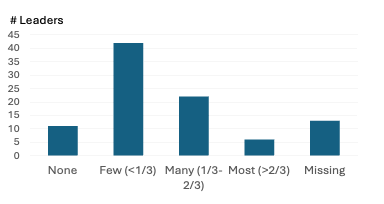 It
is noteworthy that those who knew 100 or more MBBs reported a greater proprtion
of them to have distanced themselves from the Church while remaining
strong in their faith. Also, the survey leaders with a Muslim background
reported knowing a greater proportion of MBBs who had distanced themselves
while remaining strong in their faith than did leaders with otherreligious
backgrounds. Based on these quantitative survey results, our team’s follow-up
qualitative interviews were able to uncover some practical realties about this
Fig. 6. MBBs
who have distanced themselves from the Church
It
is noteworthy that those who knew 100 or more MBBs reported a greater proprtion
of them to have distanced themselves from the Church while remaining
strong in their faith. Also, the survey leaders with a Muslim background
reported knowing a greater proportion of MBBs who had distanced themselves
while remaining strong in their faith than did leaders with otherreligious
backgrounds. Based on these quantitative survey results, our team’s follow-up
qualitative interviews were able to uncover some practical realties about this
Fig. 6. MBBs
who have distanced themselves from the Church
issue.
A couple of short stories from our interviews will be helpful to give substance to this idea that an MBB can be strong in their faith, yet distant from the Church:
I knew two people who had accepted Lord Jesus Christ in their lives, and they used to come to the church and worship joyfully, then they stopped coming… One of them is married, and his wife is still Muslim. When she had found out that he is coming to the church, she threatened him by applying for divorce. They had children, so, he made a benefits-risks-ratio evaluation. And stopped going to the church, but he is still a believer in his heart. I do not say about him that he has denied Christian faith. But he wanted to preserve his family. And he is still sending messages to us asking to pray for his family to be saved. He is still having the heart for Christ, but we consider him wise guy who is trying not to destroy his family.
Or the case below illustrates the wide grey areas that many MBBs must navigate:
[One believer] is a member of a devoutly religious family residing in a relatively remote district… He could not stop going to the mosque. He had not any choice. However, he said to me that even if he prays at the mosque according to the Islamic rituals, he is praying for Jesus Christ and in His Name. This man knew the Truth, the Way and Life. His circumstances are overwhelming. I do not know his heart. Only God knows. I can say that he is Christian, but in a wrong way.
Question Five: Returned to Islam
“How many of these Muslim Background Believers (MBB) do you know who have returned to Islam?”
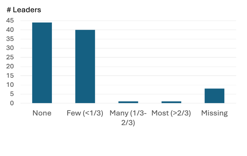
This question directly addresses the original concern that initiated this research. Almost all the church leaders said that they know of None (44) or only a Few (40) MBBs who had returned to Islam (see Figure 7 below). Only one reported that they know Many, and one reported that Most had returned to Islam. While at least some MBBs with whom church leaders had lost contact may have returned to Islam, few MBBs are actually known to have done so.
The qualitative data strongly aligned with our survey findings that few Muslims who truly turn to Christ ever turn back to practicing Islam. Note the following three responses:
No one I know who believed in Christ has left the faith.
 If
the MBB is a real believer and the real accepter of Jesus Christ as Lord and
Savior all his life. Even if he left the church, he will never go back to
Islam. He will [maybe] practice his Christianity by himself, or he will look
for another church to be a member of it… If he tasted Christ and if he knew
about the deformity of Islam. He will never go back there. Fig.
7. MBBs
who have returned to Islam
If
the MBB is a real believer and the real accepter of Jesus Christ as Lord and
Savior all his life. Even if he left the church, he will never go back to
Islam. He will [maybe] practice his Christianity by himself, or he will look
for another church to be a member of it… If he tasted Christ and if he knew
about the deformity of Islam. He will never go back there. Fig.
7. MBBs
who have returned to Islam
[If] he lived the Christian faith and [then] quit the Christian faith, but [he would] never go back to Islam. He [could] become non-religious, OK. Perhaps he may seek in ancient religions like the Greek culture or Egyptian, or even Buddhism or Hinduism, OK. But he will never go back to Islam.
Only one person said they personally knew an authentic Muslim background believer who later went back to practicing Islam. In this sad case it was her younger sister:
My sister was young and saw in Christianity a beautiful community far from the strict Islamic pressure. She decided to believe in Christ. But when they wanted to disciple her, they talked to her about Islam and its heresies, which caused her to have a negative reaction and withdraw from faith. Since we believed, my husband, children and I, have been trying to talk to her about Christ and that her path is wrong, but she does not accept it.
Combined Estimate
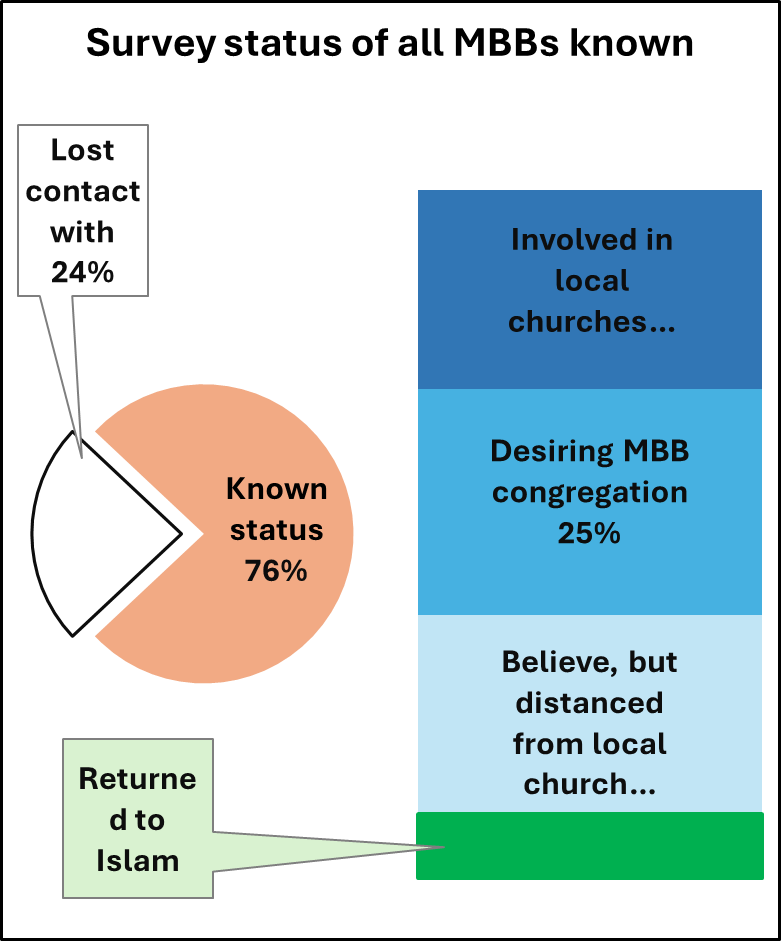
The information in the previous five figures (Figures 3-7) was combined to help understand their combined meaning and to provide a single estimated level of reversion. Each choice on the Likert scales had an associated number or ratio range. The midpoint of each range produced an average numerical response for each question for those who answered the question. This average was imputed to those who did not answer the question. The averages for questions two through five were applied to the midpoint of the number of MBBs the leader still had contact to compute overall averages (see Figure 8 below).
The first item to notice is the leaders had lost contact with one-fourth (24%) of those who they knew had placed their faith in Jesus. Those with whom they still have contact can be classified into three large and one small group:
· The largest of these (25%) are MBBs who are strong in their faith but have not found a church home and desire a MBB congregation.
· A slightly smaller group (22%) are those strong in their belief in Jesus but have distanced themselves from the local church.
· A third group (22%) of MBBs involved in local churches is inferred, although participants were not specifically asked about it.
· The smallest group (7%) is the estimate of the percent of Muslims who had put their trust in Jesus but have since returned to Islam.
Participants who came from Muslim backgrounds themselves knew about 20 more MBBs than those who came from families with other religious backgrounds. However, from our survey analysis, the number of MBBs a participant had known had no relationship with the proportions they had lost contact with or had returned to Islam.
 Participants
using the Arabic survey and who lived in the MENA region were less likely to
report MBBs returning to Islam than were those who responded in English and
lived outside the MENA region. Together, the two characteristics explain
one-fourth of the variation among participants; the language in which they
responded explained more of the variation than where they lived.
Participants
using the Arabic survey and who lived in the MENA region were less likely to
report MBBs returning to Islam than were those who responded in English and
lived outside the MENA region. Together, the two characteristics explain
one-fourth of the variation among participants; the language in which they
responded explained more of the variation than where they lived.
Care should be taken before arriving at firm conclusions from the information just cited. Moreover, discernment is needed regarding the missiological meaning behind the numbers. One can assume that anyone who used the Arabic version of the survey is either a native speaker or at least very deeply embedded in that culture. Thus, whatever statistical significance that might be attached to that linguistic distinction could very well relate to deeper cultural understanding. And if so, some reports of MBBs “going back to Islam” might be due to English-preference leaders having inadequate understanding of the social factors at play when the MBB “disappears.” This inference is not to imply that native speakers are automatically better gospel workers, but it does suggest they have insights that are important to understand the reality of this issue. Fig. 8. Survey status of all MBBs known
“What do you feel is the main reason Muslim Background Believers leave the faith?”
Responses to question four indicated this outcome of MBBs leaving faith in Jesus was rare, so some participants did not answer question six. Among those who answered the question and selected a main reason, the most (35) said it was Community pressure (see Figure 9 below).
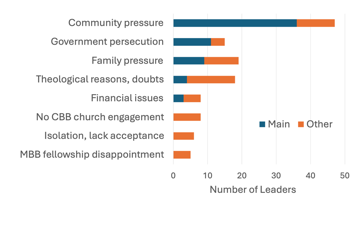 It is noteworthy that 17 participants did not specify a main
reason and, along with 25 of those who did, wrote responses giving various
reasons. Eleven of these included Community pressure among their reasons,
again, emphasizing that issue’s importance. While Government persecution was
listed more frequently than Family pressure as a main reason, the reverse is
true when listings from “other reasons” are included. Theological reasons
constituted the fourth most frequent reason, but a wide range of reasons were
listed: confusion, doubts, inadequate discipleship, and those who rejected
Islam but were not actually a believer. Also, the list of main reasons in the
survey did not include No CBB church engagement, but eight participants wrote
that not becoming engaged in a traditional church of mostly Christian
background believers (CBB) was as important a reason for returning to Islam as
financial issues. Closely related, but shown separately, were six responses
that Isolation and lack of acceptance by the Christian community can be a
factor, as can be MBB fellowship disappointment, such as not finding a place to
serve or differences with the MBB leader.
Fig. 9.
Reasons MBBs leave faith in Jesus
It is noteworthy that 17 participants did not specify a main
reason and, along with 25 of those who did, wrote responses giving various
reasons. Eleven of these included Community pressure among their reasons,
again, emphasizing that issue’s importance. While Government persecution was
listed more frequently than Family pressure as a main reason, the reverse is
true when listings from “other reasons” are included. Theological reasons
constituted the fourth most frequent reason, but a wide range of reasons were
listed: confusion, doubts, inadequate discipleship, and those who rejected
Islam but were not actually a believer. Also, the list of main reasons in the
survey did not include No CBB church engagement, but eight participants wrote
that not becoming engaged in a traditional church of mostly Christian
background believers (CBB) was as important a reason for returning to Islam as
financial issues. Closely related, but shown separately, were six responses
that Isolation and lack of acceptance by the Christian community can be a
factor, as can be MBB fellowship disappointment, such as not finding a place to
serve or differences with the MBB leader.
Fig. 9.
Reasons MBBs leave faith in Jesus
The interrelationships of survey question answers and the themes found in the comments about the reasons MBBs leave the faith and return to Islam provide some additional insights:
· The greater the proportion of MBBs the church leaders followed, the more likely they were to say Community pressure is the main reason for returning to Islam.
· The greater the proportion of MBBs that church leaders report to have not found a church home and desiring an MBB congregation, the more likely they were to include Isolation and lack of acceptance, and the less likely they were to include Theological reasons for returning to Islam.
There is still no consensus in the qualitative interview data on what the “main” reason was for MBBs turning back to Islam, but community pressure and being isolated by the community were mentioned:
I stated Community pressure, but in reality, that would be family pressure combined with community pressure—the two go hand in hand.
So, becoming a Christian, you cut yourself from a huge support group and [are] left alone… So suddenly the MBB will find himself with all his relationships are cut off and he is standing in the open air, in the desert by himself.
What a sad picture at the end of the above quote, “in the desert by himself.” Whether the speaker intended or not, the picture gives the image of hunger, thirst, and impending death.
Important to note is how several study participants mentioned the same kinds of issues that arise in any context. MBBs who leave the faith are often those who:
· neglect their relationship with God;
· don’t apply the Word of God to their lives;
· do not spend time in prayer or meditation on the Word of God.
This list reminds us that, while some reasons are linked to the harshness of the Muslim context, others are problems common to any cultural background. This point in our discussion leads perfectly to the next and final question from our survey.
Question Seven: Strengthen Faith
“What is the main practice that helps MBBs remain strong in their faith in Jesus?”
 A
majority (57) of participants indicated Fellowship with other MBBs is
the “main” practice that maintains strong faith. An additional 19 included this
reason among the survey’s “Other” responses. That is, a total of 76 out of the
94 church leaders who took the survey (81%) cited “Fellowship with other MBBs”
as either the main practice, or one of the significant practices, that keep
MBBs strong in Christ (see Figure 10).
A
majority (57) of participants indicated Fellowship with other MBBs is
the “main” practice that maintains strong faith. An additional 19 included this
reason among the survey’s “Other” responses. That is, a total of 76 out of the
94 church leaders who took the survey (81%) cited “Fellowship with other MBBs”
as either the main practice, or one of the significant practices, that keep
MBBs strong in Christ (see Figure 10).
Some written comments help to explain this finding:
If Muslims don't have a house church comprised of other MBBs or other family members who believe, there is enormous pressure to return to Islam.
[It’s the] lack of contextualized community that allowed them to remain their ethnic identity, while growing in their faith, in the face of the other pressures.
One person put it slightly differently: Fig. 10. Practices helping MBBs remain strong
It's not pressure but the desire to be part of community, and the MBBs have not found acceptance with Christian background people, or they have not found a Christian replacement for the family and community that they lost… Their only hope is to find an MBB community.
MBBs do not encounter problems with churches they try to join because those churches are bad, nor are the Christian background believers the MBBs meet uncaring. Rather, problems between MBBs and churches can arise due to vast cultural differences. MBBs have trouble finding the same level of community they knew in Islam because Christian background believers do not interact well with them. It is important that MBBs find community with other believers who have the same expectations.
Important to note is that a significant number of respondents selected a much more common, and less contextually particular, practice as important to MBBs being strong--Bible reading/listening. Several other issues were volunteered, like Prayer or Preaching, but not often. This relative lack of mention does not mean that those practices are unimportant, but it does appear they are secondary to fellowship with other MBBs and being in God’s word.
Correlation is not the same as causation, but church leaders who report a greater proportion of MBBs dropping out of contact tend to also report that Bible reading, prayer and other Christian actions are the main practices that keep MBBs strong. Collectively all the data strongly suggests that MBBs having fellowship with other MBBs is key to their perseverance in Christ.
Discussion and Recommendations
The research team was encouraged by the number of church leaders who participated in this study. This sensitive topic of MBB attrition is not easy to inquire about, but we were blessed with a diversity of the participants across several dimensions: geography, gender distribution, family background, and length of ministry among Muslims. This combination of sample size and diversity gives our team confidence in our findings, especially when applied to the Middle East and North Africa. This article also helps shed light on a range of MBBs issues related to integration into churches, a topic that should be explored in additional research.
This study had as its primary research question, “What is the rate of MBBs who return to Islam?” Our research team came up with our best numerical estimate of 7%. This finding makes it clear that the rate of MBBs returning to Islam in the Middle East region is not nearly as high today as in the past as suggested by early reports. However, the 7% rate only applies to MBBs about whom these ministry leaders still have knowledge. What if all those who have dropped out of contact have all returned to Islam? We can estimate this worst-case scenario by combining those MBBs known to have returned to Islam with the MBBs who have dropped out of contact. However, these two percentages, found in Figure 8 above, are based on different wholes and cannot be added directly. Once we account for the differing percentage bases, we arrive at 29% of the original that could have possibly turned back to Islam. However, findings from both the quantitative and qualitative parts of our study show that about half of the MBBs the leaders know about are not actively in a church fellowship for many different reasons. When considered in this way it becomes clear that “dropping out of contact” is not the same as “returning to Islam.” Reason suggests that some who have dropped out of contact became “secret believers,” others formed connections to different churches or fellowships not known to the leaders, and some emigrated.
While our choice of study methodology does not give us a precise answer, we have calculated a very small 7% rate of apostasy based on the experience of nearly 100 ministry leaders in the Muslim world. Even the very worst case of 29% is much less than some have feared. A written comment in the survey’s question about reasons MBBs leave the faith may partially explain why:
Around 2007, I talked with XXX who had served as the director of the Arab World broadcast of Trans World Radio for 15 years. He said that they had an organization do a survey in N. Africa of radio listeners that gave opportunity to follow up on MBBs who came to faith… They found that over 95% reverted back to Islam within 3-5 years… As I recall, they attempted to connect these people by forming small groups/churches, but without much success.
However, from 2008 to 2013, the Global Response Management System, a consortium of 17 TV, radio, and website broadcasts composed of 17 broadcasters, documented results of listeners’ contacts. The results showed that 6% of people who contacted the broadcasters were interested enough in Jesus to requested visits by local MBBs. Relevant to retention, half of those who received a local visit by an MBB were known to be involved in a fellowship of local MBBs by the end of the six-year data collection period (Bonham, 2023).
Our study confirms that leaving behind their community and culture are one of the primary pressures faced by MBBs as they seek to live out their faith in Christ. Furthermore, our survey supports the idea that many MBBs, perhaps most, attend local fellowships or churches, even while they navigate many cultural, sociological, emotional, and spiritual difficulties which are part of that integration. However, many if not most would benefit by being part of an MBB community in which they could grow in their faith and resist the pressure of their Muslim family and community.
Based on this initial study, our team has three recommendations related to further study needed regarding MBB reversion, and their communities:
1. This survey was designed in such a way that it can be used in other ministry settings, other languages, or other focused regions of the Muslim world. We anticipate that this study can be easily replicated in populations other than those we sampled with this study.
2. Because this kind of study can generate opposition, we highly recommend that a prayer team be formed for actively moving forward in this kind of inquiry and for greater clarity about God’s work in the Muslim world.
3. With Europe receiving so many Muslim immigrants the past few years, it might be wise to study this issue there. Perhaps the global mission community elsewhere, where churches receive thousands of MBBs, could learn from the challenging experience of MBBs in Europe.
We also recommend that readers join us in the following prayer points:
· Lord, we seek you for what ministry leaders can do to safely and appropriately maintain better connection with MBBs who have come to faith in you and grow in discipleship.
· Lord, may your Holy Spirit lead and guide your Church into empathy and compassion for meeting the many challenges that MBBs face in finding healthy communities of faith for their families in local churches and fellowships.
· Lord, are their courageous and practical ways that local churches and congregations with MBB communities can gather in mutually supportive community to learn from each other what the other might share about the whole Body of Christ worshiping God in spirit and in truth?
References
Bonham, G. (2023). Can Muslims be reached with the gospel? Findings from three research studies. Global Missiology. October, 20(4), pp. 55-64.
http://ojs.globalmissiology.org/index.php/english/article/view/2799
Communio Messianica (2025). Who we are. Communio Messianica. https://www.communiomessianica.org/about
Daniels, G. (2021). “How exactly do we know what we know about kingdom movements?” In Warrick Farah (Ed.), Motus Dei: The Movement of God to Disciple the Nations (pp. 58-67). Littleton, CO: William Carey Publishing.
Span, J. (2020). Reversion: Why do “Christian Converts” from Islam return to their old religion? Global Missiology. July, 4(17). http://ojs.globalmissiology.org/index.php/english/article/view/2398